
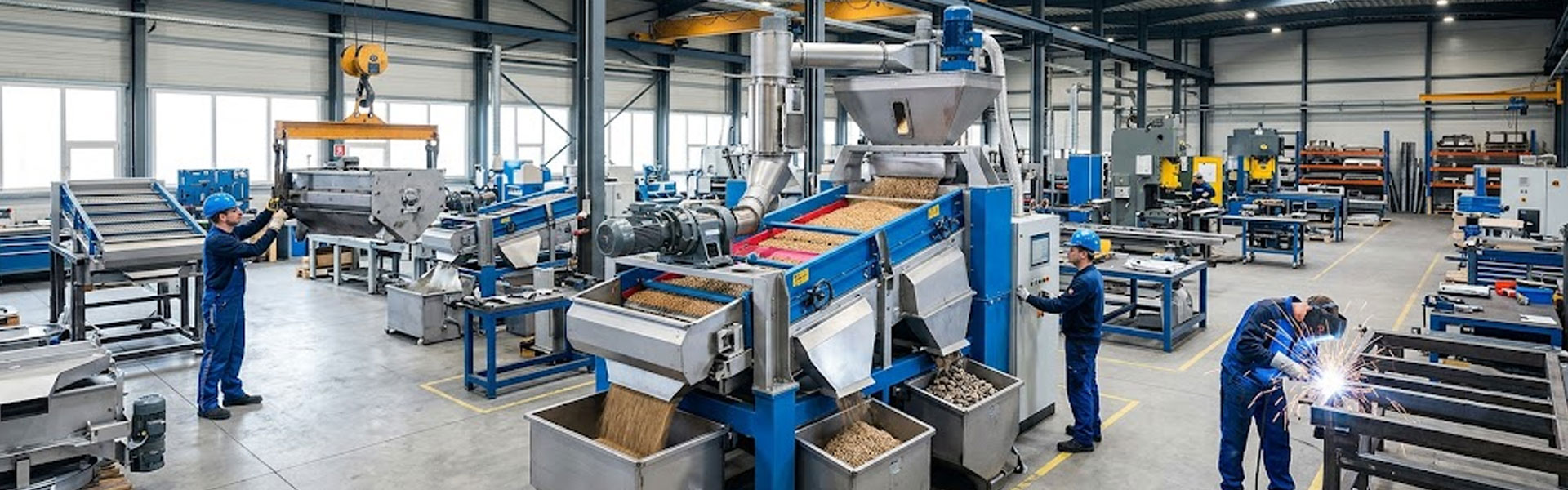
Rice Destoner Manufacturer
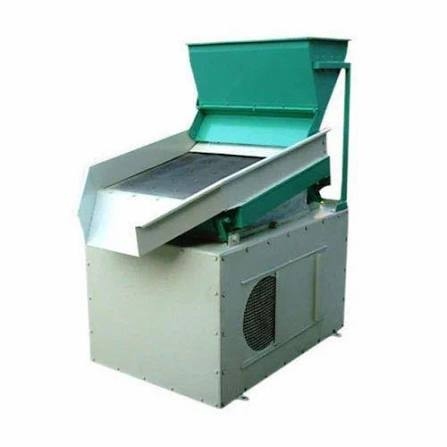
Product Profile
Annovaa Industries Pvt. Ltd. is a manufactures of Rice Destoner Machines for rice mills and grain-processing units in Kolkata and across West Bengal, Jharkhand, Odisha, Assam and Chhattisgarh. Instead of treating destoning as simply another cleaning stage, the machine is designed around one specific problem: removing dense particles that can be almost the same size as paddy but considerably heavier. A destoner uses controlled airflow and deck movement to create density-based separation. This is different from ordinary screening, which mainly separates materials by size.
The Real Job of a Rice Destoner
Paddy arriving at a rice mill can contain stones, mud lumps and other heavy particles. Some of these contaminants may be difficult to remove with conventional sieving when they are close to the size of the grain.
This is where the Rice Destoner Machine becomes valuable.
The machine creates a controlled separation environment where:
- Lighter paddy remains in the upper material layer.
- Heavier stones settle towards the deck.
- Controlled airflow helps stratify the material.
- The moving deck directs the heavy fraction towards a separate discharge.
- Clean paddy follows a different path towards the grain outlet.
This operating principle is based on differences in specific gravity rather than simply particle size.
Why Rice Needs a Dedicated Destoning Stage
A pre-cleaner and a destoner do not perform exactly the same job.
Cleaning Equipment | Main Separation |
Pre-cleaner | Larger, smaller and lighter foreign matter |
Aspirator | Dust, husk and lightweight particles |
Magnet | Ferrous metal particles |
Rice Destoner | Dense stones and heavy particles |
Rice Grader | Separation according to grain size |
This distinction is important when planning a rice-processing line. A stone that is close to the size of paddy can pass through a size-based cleaning stage, whereas a gravity destoner is specifically intended to exploit its higher density.
A Different Approach to Machine Design
At Annovaa Industries Pvt. Ltd., the focus for a Rice Destoner is not merely on making the machine vibrate. The important consideration is the relationship between feed distribution, deck movement, airflow and material behaviour.
The machine is developed around several practical considerations:
- Even Material Distribution
If paddy accumulates heavily on one portion of the deck, the separation conditions can become uneven. The feeding arrangement therefore plays an important role in allowing the material to spread across the working surface.
- Controlled Air Movement
Too little air may not create adequate stratification, while excessive airflow can disturb the material and increase the possibility of good grain travelling with the rejected fraction. Proper airflow adjustment is therefore central to destoner operation.
- Balanced Deck Movement
The deck movement needs to provide sufficient directional action for dense particles without unnecessarily disturbing the grain layer.
- Separate Material Routes
The machine maintains separate discharge paths for cleaned rice/paddy and heavy rejected material, making the separation process continuous.
How We Build a Rice Destoner
Annovaa Industries Pvt. Ltd. approaches manufacturing as a sequence of coordinated mechanical stages rather than simply assembling standard components.
- Frame & Body Fabrication
The main structure is fabricated to provide sufficient rigidity and support for the deck, drive system, airflow arrangement and material-handling components.
- Working Deck Preparation
The separation deck is prepared with an appropriate perforated working surface and mounting arrangement. Its condition is important because the material must move consistently across the deck.
- Air Chamber Arrangement
An air distribution section is incorporated beneath or around the working deck according to the machine configuration. Its purpose is to deliver controlled airflow through the grain bed.
- Drive Assembly
The movement mechanism is fitted to provide the required oscillating or vibrating action of the deck.
- Feeding Arrangement
The inlet is designed to introduce paddy onto the working surface in a controlled manner rather than creating an uneven pile.
- Discharge Configuration
Separate outlets are provided for the cleaned material and heavy contaminants.
- Final Machine Checking
The completed unit is checked for deck movement, airflow behaviour, structural stability, drive operation and general material-flow performance before supply.
Materials & Quality We Consider
For a machine operating continuously in a rice mill, construction quality affects both durability and operating consistency.
Annovaa Industries Pvt. Ltd. focuses on:
- Strong fabricated machine structure
- Properly finished working deck
- Durable mechanical components
- Reliable drive arrangement
- Suitable bearings and supports
- Correctly assembled fasteners
- Smooth material-contact surfaces
- Properly aligned moving parts
- Stable airflow arrangement
- Industrial-quality electrical components
- Suitable surface protection
- Pre-dispatch inspection
For food-processing environments, material selection can also be considered according to the part of the machine that comes into contact with the grain and the customer’s hygiene requirements.
Technical Specification – Rice Destoner
Parameter | Specification |
Machine Type | Rice / Paddy Destoner |
Primary Function | Removal of stones and dense impurities |
Separation Method | Gravity, airflow & deck movement |
Suitable Material | Paddy, rice and selected grains |
Feed | Controlled grain feeding |
Working Surface | Perforated separation deck |
Air System | Controlled airflow arrangement |
Deck Movement | Reciprocating / vibrating type, depending on design |
Product Outlet | Separate clean-grain discharge |
Stone Outlet | Separate heavy-particle discharge |
Drive | Motorised |
Capacity | Application and model dependent |
Power Requirement | Model dependent |
Installation | Rice mill / grain-processing line |
Adjustment | Airflow, deck inclination and operating parameters as applicable |
Exact capacity, motor rating, deck dimensions and power consumption should be finalised according to the paddy variety, moisture condition, impurity load and required production rate rather than using one specification for every installation.
Features Developed for Rice-Milling Conditions
- Density-Based Cleaning
The machine is designed specifically for situations where stones and paddy may have comparable dimensions but different densities.
- Continuous Stone Discharge
Heavy contaminants can be directed towards a dedicated outlet during operation rather than requiring repeated manual separation.
- Airflow Adjustment
The air setting can be adapted to the material behaviour and operating condition. Adjustable airflow is an important part of gravity-destoner operation.
- Working-Deck Accessibility
The deck and relevant operating sections can be designed for practical inspection and cleaning.
- Processing-Line Integration
The Rice Destoner can be positioned within a larger rice-cleaning arrangement rather than being treated as an isolated machine.
- Reduced Dependence on Manual Sorting
Mechanical density separation reduces the need to depend entirely on manual removal of heavy foreign particles.
What Can Affect Destoning Performance?
One unique aspect of destoning is that machine capacity alone does not determine separation quality.
Performance can change according to:
- Paddy variety
- Moisture condition
- Feed rate
- Stone concentration
- Stone size
- Grain density
- Air volume
- Deck inclination
- Deck movement
- Material distribution across the deck
This is why the same operating setting should not automatically be used for every type of paddy. Controlled airflow and deck adjustment are important to obtain the desired separation.
Where Annovaa Industries Pvt. Ltd. Rice Destoners Can Be Used
The machines can be incorporated into:
- Rice mills
- Paddy-processing plants
- Parboiled rice plants
- Grain-cleaning facilities
- Agricultural processing units
- Integrated rice-milling lines
- Commercial grain-processing plants
- Small and medium rice-processing operations
For customers in Kolkata and West Bengal, as well as rice-processing businesses in Jharkhand, Odisha, Assam and Chhattisgarh, Annovaa Industries Pvt. Ltd. can supply the machine according to the intended processing arrangement.
Protecting the Machines That Come After It
A Rice Destoner is not only about producing visually cleaner paddy. It also acts as an important protective stage before equipment such as huskers, rubber-roll systems and other milling machinery. Heavy foreign objects entering downstream machinery can cause mechanical damage and unnecessary interruptions. Rice-processing references specifically identify destoning as a stage used to remove dense impurities before further milling. This makes the destoner an important part of the overall protection strategy of a rice mill, rather than simply another cleaning machine.
Why Annovaa Industries Pvt. Ltd.?
- Requirement-Based Selection
We consider the intended crop, production requirement and position of the destoner within the processing line.
- Practical Engineering
Our approach focuses on material movement, airflow and mechanical operation rather than relying only on nominal machine capacity.
- Quality-Conscious Construction
Attention is given to structural fabrication, working surfaces, drive components and assembly quality.
- Flexible Industrial Applications
The machine can be supplied for different rice-processing and grain-cleaning requirements.
- Regional Service Area
Annovaa Industries Pvt. Ltd. supplies Rice Destoner Machines to customers in Kolkata, West Bengal, Jharkhand, Odisha, Assam and Chhattisgarh.
- Support for Processing Projects
Whether the requirement is for a new rice mill, an expansion project or replacement of existing cleaning equipment, the machine can be selected according to the actual processing arrangement.
Rice Destoner Manufacturer for Modern Grain Processing
A good Rice Destoner should do more than separate stones from paddy. It should create a controlled material environment in which airflow, deck movement, feed distribution and density differences work together. Annovaa Industries Pvt. Ltd. supplies Rice Destoner Machines designed for this purpose, helping rice-processing businesses in Kolkata and across West Bengal, Jharkhand, Odisha, Assam and Chhattisgarh establish a dedicated heavy-impurity removal stage before further milling. For Rice Destoner Machine requirements, contact Annovaa Industries Pvt. Ltd. for model selection, technical details and application-specific specifications.