
Cyclone Separator Manufacturer
Product Explore Our Product Range
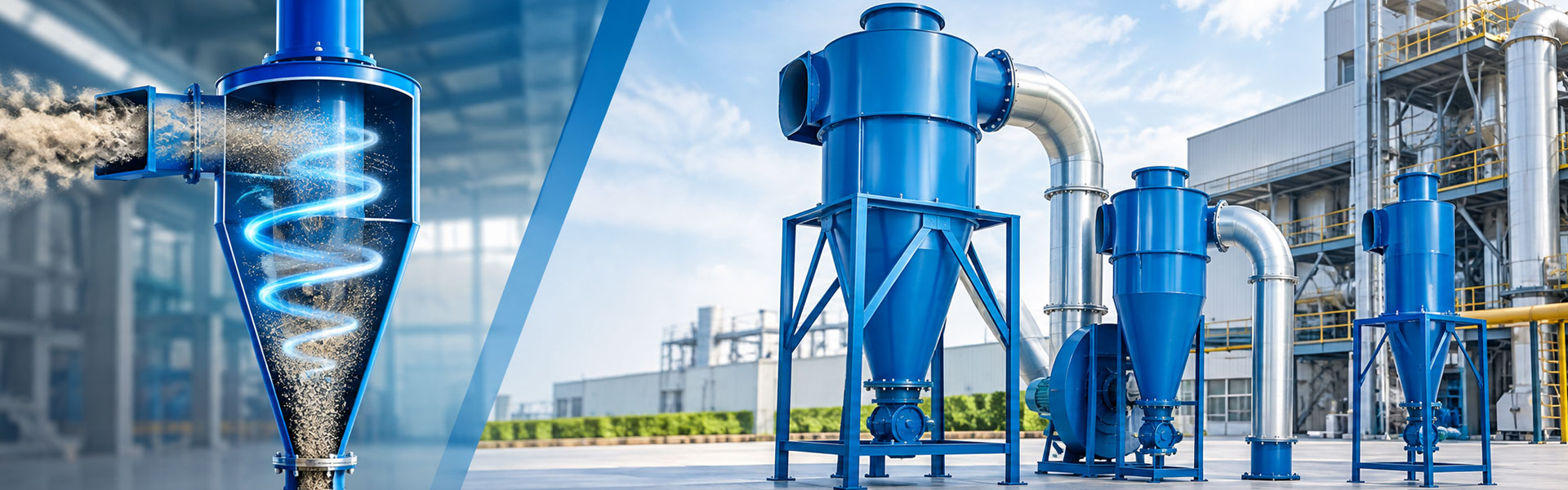
Annovaa Industries Pvt. Ltd. well known manufactures of Cyclone Separators for industrial applications involving dust-laden air, gases and bulk particulate materials. The equipment uses centrifugal action to separate heavier particles from an air or gas stream before the stream moves toward downstream filtration or exhaust equipment.
Cyclone Separators can be incorporated into pneumatic conveying, dust collection and material recovery arrangements. Their configuration can be developed according to airflow, particle characteristics, temperature, material loading and the required separation stage.
What Makes This Product Different?
A Cyclone Separator performs mechanical separation without relying on filter bags or cartridges for its primary separation process. The incoming air enters the cyclone in a controlled swirling motion, causing relatively heavier particles to move toward the outer wall and travel downward toward the collection outlet.
Key characteristics include:
- Vortex-Based Separationfor removing suitable particulate matter from air or gas.
- Rugged Constructionfor demanding industrial environments.
- Continuous Particle Dischargethrough the lower outlet.
- Low Mechanical Complexitybecause the basic cyclone has no rotating internal separation mechanism.
- Adaptable Inlet and Outlet Designaccording to the connected ducting.
- Downstream Equipment Protectionby reducing the particulate burden reaching secondary filtration.
- Application-Specific Fabricationbased on process conditions and installation requirements.
Product Dimensions & Ratings
Cyclone dimensions should be established from the required airflow and separation conditions rather than selecting a standard body size without process information.
Parameter | Configuration |
Equipment Type | Cyclone Separator |
Separation Medium | Air / Process Gas |
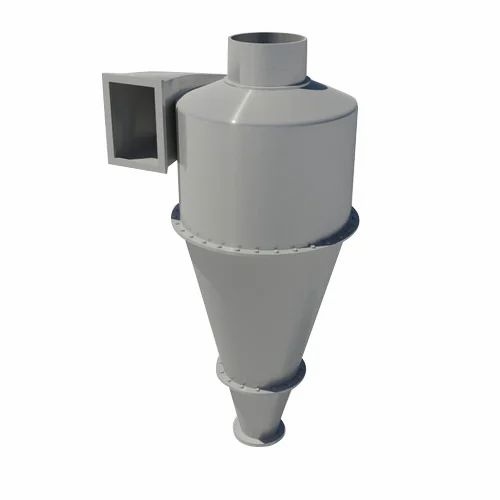
Inlet Arrangement | Tangential |
Body Design | Cylindrical with Conical Section |
Material of Construction | MS / SS / Application-Specific |
Airflow Capacity | Application-Based |
Operating Temperature | Based on Process Requirement |
Particle Type | Dust / Powder / Granules / Solid Particles |
Dust Outlet | Standard / Customized |
Air Outlet | Top Outlet / Customized |
Collection Arrangement | Hopper / Bin / Connected Equipment |
Installation | Vertical / Process-Specific Arrangement |
The final diameter, height, inlet size, outlet dimensions, material thickness and pressure-drop characteristics should be determined after reviewing the actual process conditions.
Performance Advantages
A suitably designed cyclone can provide several operational advantages in industrial dust and material-handling systems:
- Efficient Coarse Particle Separationfrom suitable air streams.
- Reduced Load on Secondary Filtersby removing heavier particles before fine filtration.
- Continuous Operationfor applications requiring ongoing air-material separation.
- Material Recoverywhere separated solids need to be collected for further processing.
- Straightforward Maintenancedue to the comparatively simple mechanical arrangement.
- Suitable for High Dust Loadingin applications where the cyclone is correctly sized.
- Integration with Existing Systemssuch as bag filters, blowers, ducts, hoppers and pneumatic conveying lines.
For very fine particles, cyclone performance depends strongly on particle size, density and operating conditions; additional filtration may be required when stringent particulate-emission limits apply.
Reasons to Partner With Us
Annovaa Industries Pvt. Ltd. focuses on matching the Cyclone Separator configuration with the customer’s actual process instead of applying one identical specification to every installation.
Before finalising the equipment, important details can include:
- Required air volume
- Type of dust or material
- Particle-size range
- Material concentration
- Process temperature
- Available installation area
- Required collection capacity
- Existing duct size
- Downstream filter or exhaust arrangement
This information helps establish a more suitable cyclone configuration for the intended industrial application.
Trusted Across Multiple Sectors
Cyclone Separators can be used in a wide range of industries where particulate separation from air or gas is required.
- Flour & Grain Processing
Used in suitable dust-control and pneumatic conveying arrangements for grain, flour and other processed materials.
- Cement & Construction Materials
Can support particulate separation and material-handling systems in cement and related processing facilities.
- Chemical Industries
Suitable for selected powder-handling and process-air applications where the material properties are compatible with cyclone separation.
- Mineral & Mining Operations
Can be incorporated into dust-handling systems involving suitable mineral particles.
- Food Processing
Used in selected powder and granular-material handling applications with appropriate construction and hygiene considerations.
- Biomass & Wood Processing
Can assist in separating compatible dust, chips and particulate material from extraction air.
- Manufacturing Plants
Useful as part of industrial dust collection, material recovery and process-air cleaning arrangements.
Why Industries Prefer Our Cyclone Separator
Industries often select cyclone technology where they need a robust mechanical method for separating relatively coarse particles without making filter media the primary separation mechanism. A well-engineered unit can also serve as a pre-separation stage, allowing heavier particulate material to be removed before the air reaches a bag filter, cartridge filter or other fine-filtration equipment.
Annovaa Industries Pvt. Ltd. can develop the equipment around the available process conditions, making the Cyclone Separator suitable for integration with the customer’s existing material-handling or dust-control arrangement.
Contact Annovaa Industries Pvt. Ltd. for Cyclone Separator
If you require a Cyclone Separator manufacturer in Kolkata, West Bengal, Jharkhand, Odisha, Assam or Chhattisgarh, contact Annovaa Industries Pvt. Ltd. with your application details. For equipment assessment, provide the airflow requirement, material name, approximate particle size, operating temperature, dust concentration and available installation space. These technical inputs can help determine the appropriate cyclone dimensions and configuration for your plant.